

Paul Verhoeven did not arrive in Hollywood to assimilate; he arrived to SUBVERT. His films RoboCop and Starship Troopers operate as Trojan horses: extravagant, violent, deliberately excessive, they deliver spectacle as distraction while quietly embedding critique. The audience is not positioned as a distant observer but as a participant—flattered, entertained, and, ultimately, implicated.
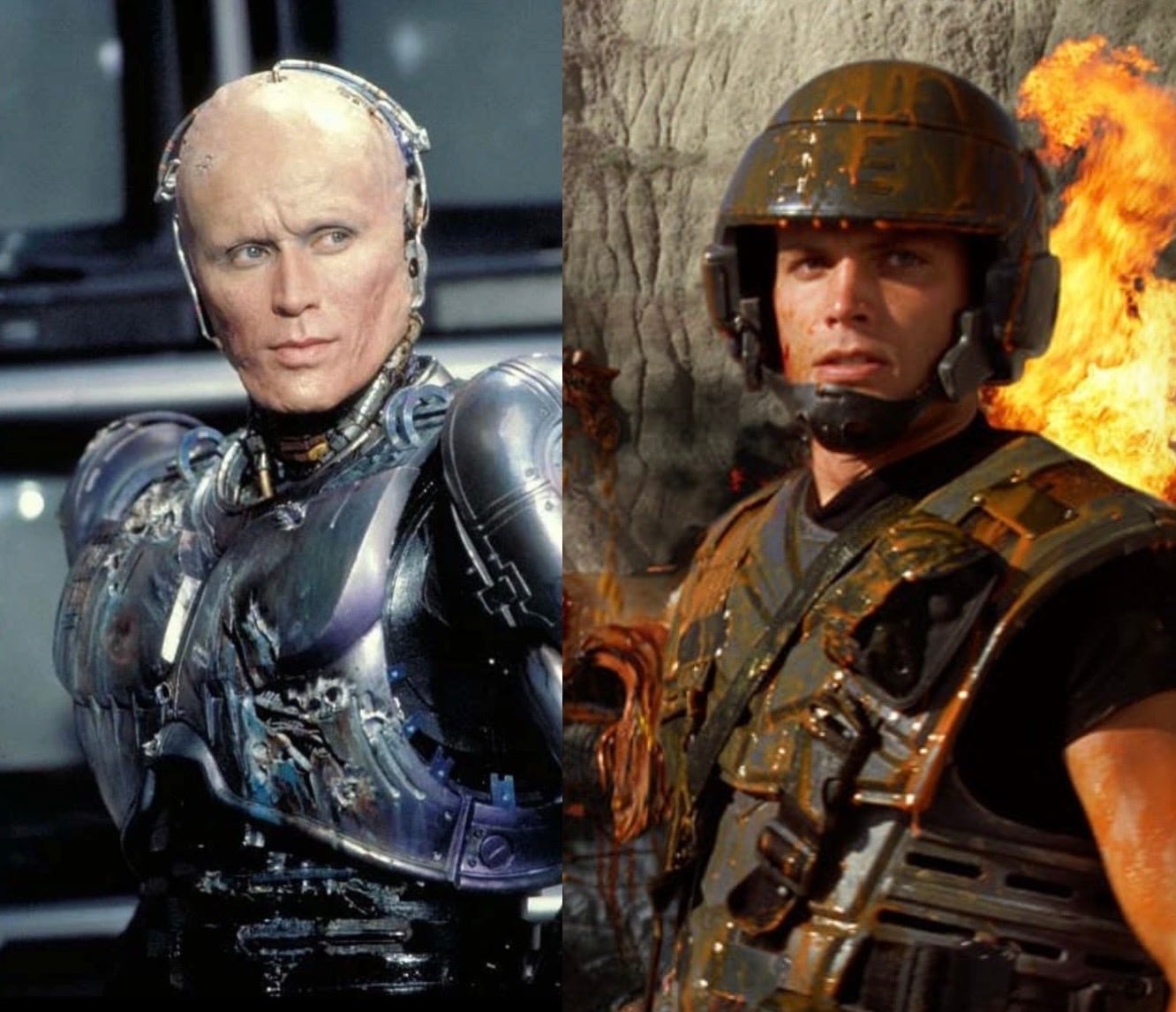
RoboCop presents itself as a work of excess—baroque violence, grotesque corporate villains, and a media landscape so absurd it borders on parody, all centered on a murdered Detroit police officer resurrected as a corporate-owned cyborg. Yet the exaggeration is precise rather than indulgent. Verhoeven’s dystopian near-future Detroit is not merely decaying; it has been systematically hollowed out and repurposed as a testing ground for corporate sovereignty. “OCP” (Omni Consumer Products, the central fictional corporatocratic megacorporation of the RoboCop franchise) does not “govern” in any traditional sense, rather it acquires, restructures, and monetizes.
“I’d buy THAT for a dollar!” - RoboCop (1987)
The titular figure is less a hero than a conclusion. Murdered Detroit police officer Alex Murphy (played by the inimitable Dr. Peter Weller) is reconstructed as intellectual property lovingly nicknamed “RoboCop” and represents the logical endpoint of a system in which human value is subordinate to utility. If Prometheus once symbolized humanity being dangerously gifted power, Verhoeven offers a more contemporary inversion: power not stolen, but repossessed—standardized, regulated, and sold back under contract. Officer Murphy’s body is become an asset; his identity, the dangerous liability needing management.
Of course there is another more pointed irony embedded in RoboCop’s mechanical cyborg-esque form—one that would not be out of place in the language of the Italian High Renaissance. The figure presented to us is unmistakably idealized: symmetrical, proportioned, engineered toward a kind of mechanical perfection. It recalls not merely the period fixation on harmonious form, but its more ambitious project—the use of the human body as a system of measurement, a way of rendering order visible and legible. In Da Vinci’s L’uomo Vitruviano (the Vitruvian Man), the figure is not simply beautiful; it is explanatory. The body becomes a schema through which architecture, proportion, and the structure of the world itself can be understood.
Verhoeven’s intervention is to submit that schema to industrial logic.
What was once a model for understanding becomes a template for control. The body remains perfect—perhaps more perfect than the Renaissance ever imagined—but its purpose has been quietly and completely reassigned. Not contemplation, not inquiry, but function. Enforcement. Output.
Of course, the figure is not simply idealized—it is made useful. Today, we might call that “optimization”.
As Dr. Weller, (RoboCop himself) argues in his doctoral work¹ on Renaissance political structures, systems of power often cloak themselves in the language of order and legitimacy—a dynamic that RoboCop renders in brutally literal terms. The fact that nearly three decades after RoboCop premiered, Dr. Weller would write a doctoral dissertation on Renaissance systems of power feels less like trivia and more like a strange kind of continuity—the man inside the machine studying the architectures of control that RoboCop only dramatizes.
What once was read as satire now registers in the zeitgeist ledger with uncomfortable familiarity. The gradual privatization of public systems, the outsourcing of state functions, and the steady reframing of individuals as “users” rather than citizens suggest that Verhoeven’s exaggerations were less speculative than diagnostic. Perhaps there was always a certain inevitability to the current state of affairs in which we now find ourselves. The language of markets has not merely influenced governance—it has replaced it.
Yet RoboCop’s most subversive gesture is not its critique, but its method. Verhoeven does not instruct the audience in what to think; he conditions us in how to feel. The experience begins with rhythm—violence, humor, spectacle—establishing a pattern of response before any critical distance can be established.
In this respect, the film bears an unexpected resemblance to The Karate Kid. Instruction is disguised as repetition, discipline concealed within apparent triviality. The lesson is absorbed long before it is understood. Verhoeven’s variation simply replaces Mr. Miyagi’s “wax on, wax off” with gunfire and spectacle, training the viewer in the emotional grammar of the system before revealing its structure.
By the time the audience recognizes the critique, we have already internalized the response.
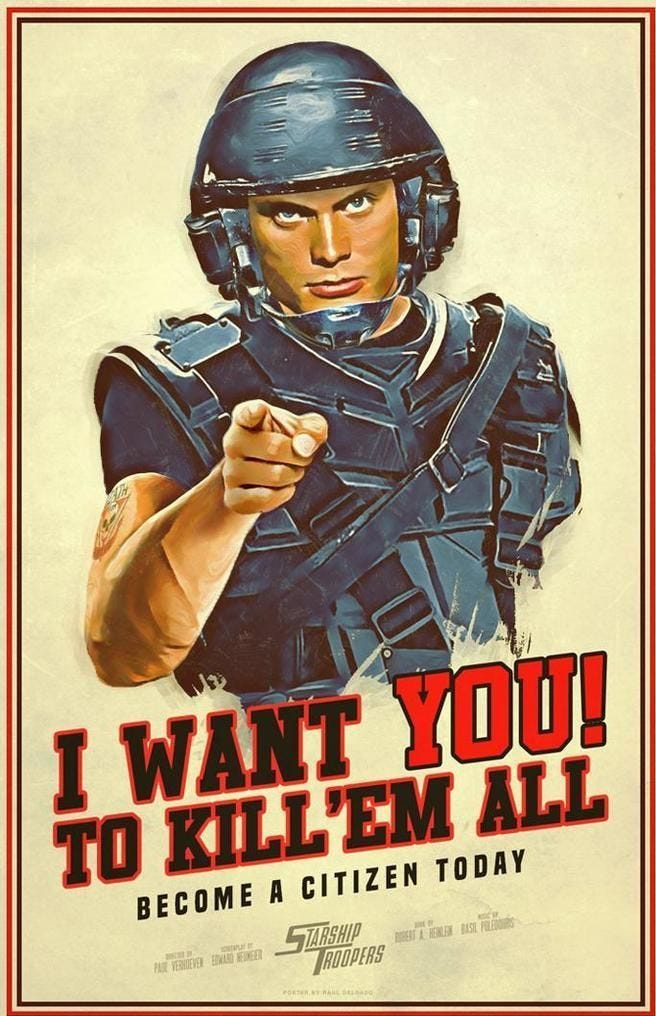
Starship Troopers extends the analysis to the aesthetics of authoritarianism. The film follows a protagonist group of young recruits in a militarized future where citizenship is earned through service and war is both constant and culturally glorified. Frequently misread as a straightforward, grotesque alien-battling action film, it is in fact, a meticulous study in ideological seduction. Its future society is clean, efficient, and devoid of visible dissent— a world in which citizenship is earned through military service and violence is recast as civic virtue.
The intellectual lineage is neither obscure nor particularly modern. The framework echoes the political logic articulated in Thomas Hobbes’ 17th century foundational tome Leviathan, (though perhaps stripped of its philosophical caution) and shows us a future in which authority is not merely accepted but celebrated. Legitimacy reinforced through spectacle rather than consent. But parallels extend even further back.
The conflation of citizenship with service, the reliance on a perpetual external enemy, and the transformation of warfare into a mechanism of identity—what the Romans would have recognized as a kind of civic virtus—all find precedent in the structures of the Roman state. Julius Caesar, elevated through the loyalty of his armies and the theater of conquest after crossing the Rubicon, nonetheless maintained the fiction of the Roman Republic—its offices preserved, its rituals observed, its authority increasingly performative.
“The only good bug is a dead bug.” - Starship Troopers (1997)
Starship Troopers’ most effective device lies in its construction of the enemy. The arachnid “bugs” are not presented as adversaries so much as abstractions—faceless, collective, and therefore exempt from moral consideration. They are not characters to be understood, but obstacles to be eliminated.
This strategy is neither novel nor especially subtle. It draws on a long historical tradition in which dehumanization serves as the necessary precondition for unrestrained violence. Complexity is not defeated; it is removed.
What distinguishes Verhoeven is his refusal to interrupt this logic. He does not step outside the frame to condemn it. Instead, he intensifies the seduction. The propaganda functions too well. The spectacle is too compelling. The audience is not distanced from the system but drawn into alignment with it.
That this alignment remains effective is perhaps the film’s most unsettling achievement. It suggests not a failure of the system, but something far less convenient: a failure of the viewer.
To revisit RoboCop and Starship Troopers in the present moment is to encounter not prophecy, but recognition. The convergence of corporate and governmental power, the normalization of surveillance, and the increasing sophistication of media-driven persuasion have rendered Verhoeven’s worlds less speculative than familiar. Propaganda has not diminished; it has evolved—becoming more diffuse, more immediate, and more seamlessly integrated into everyday experience.
The distinction between information and entertainment has not collapsed so much as dissolved.
Verhoeven’s central insight is both simple and deeply uncomfortable: systems of power do not sustain themselves through coercion alone. They endure because they are compelling—because they provide narrative, spectacle, and a sense of participation. People do not merely tolerate them; they engage with them, often enthusiastically.
It would be convenient yet misleading to describe these films as cautionary. They do not offer a clear vantage point from which the audience can safely observe and judge. Instead, they implicate the viewer directly, collapsing the distance between critique and participation.
If RoboCop represents the commodification of the individual, then Starship Troopers represents the aestheticization of power itself. Together, they form not a warning about a distant future, but an examination of a present condition—one in which systems of control are not only accepted, but performed, reinforced, and, at times, enthusiastically applauded.
The discomfort lies not in recognizing these systems, but in acknowledging how readily we adapt to them. And, more troubling still, how much we enjoy it.
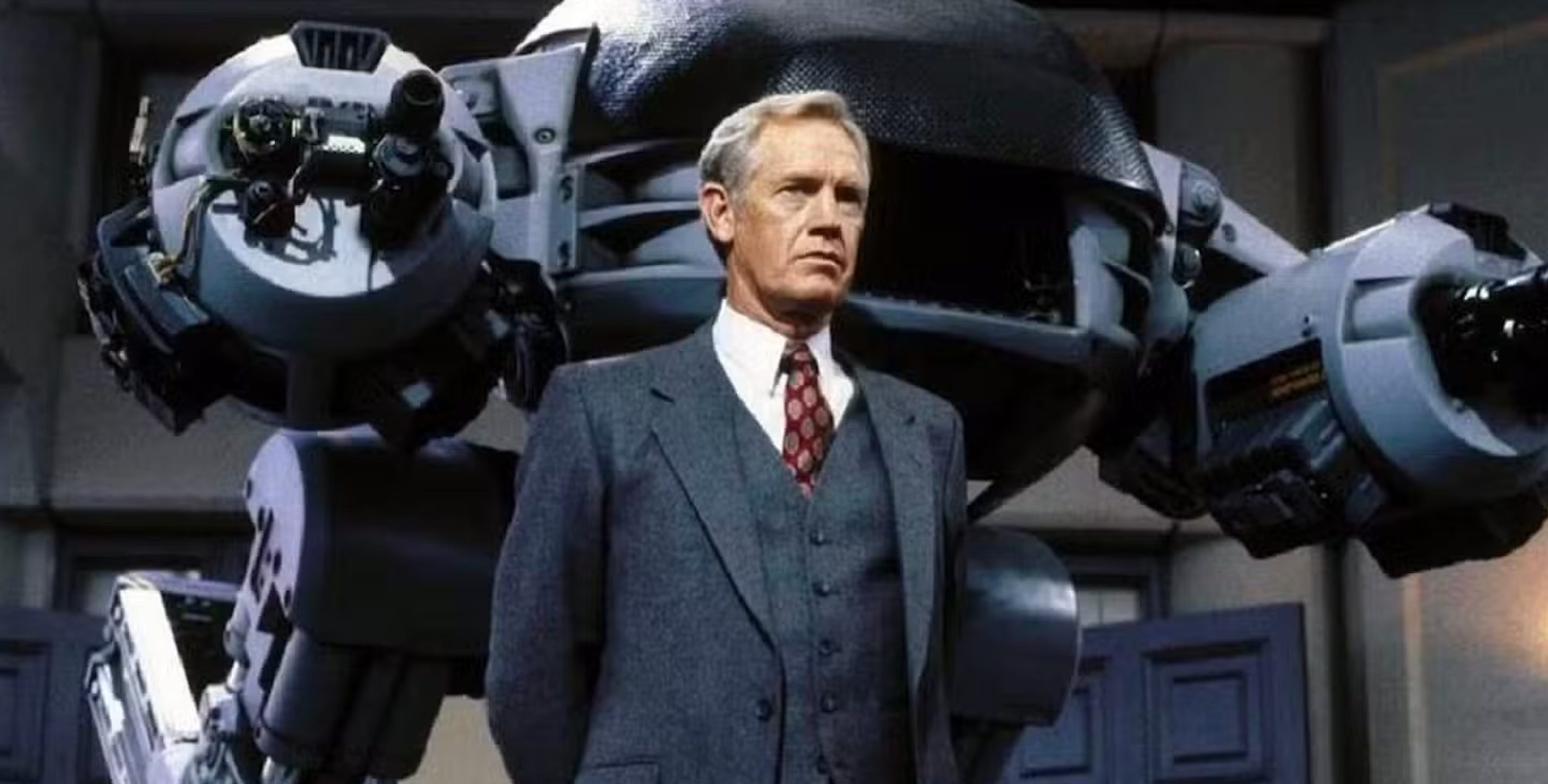
“They'll fix you. They fix everything.”
References
Weller, Peter Francis (2014). Alberti Before Florence: Early Sources Informing Leon Battista Alberti's De Pictura (PhD thesis). UCLA.