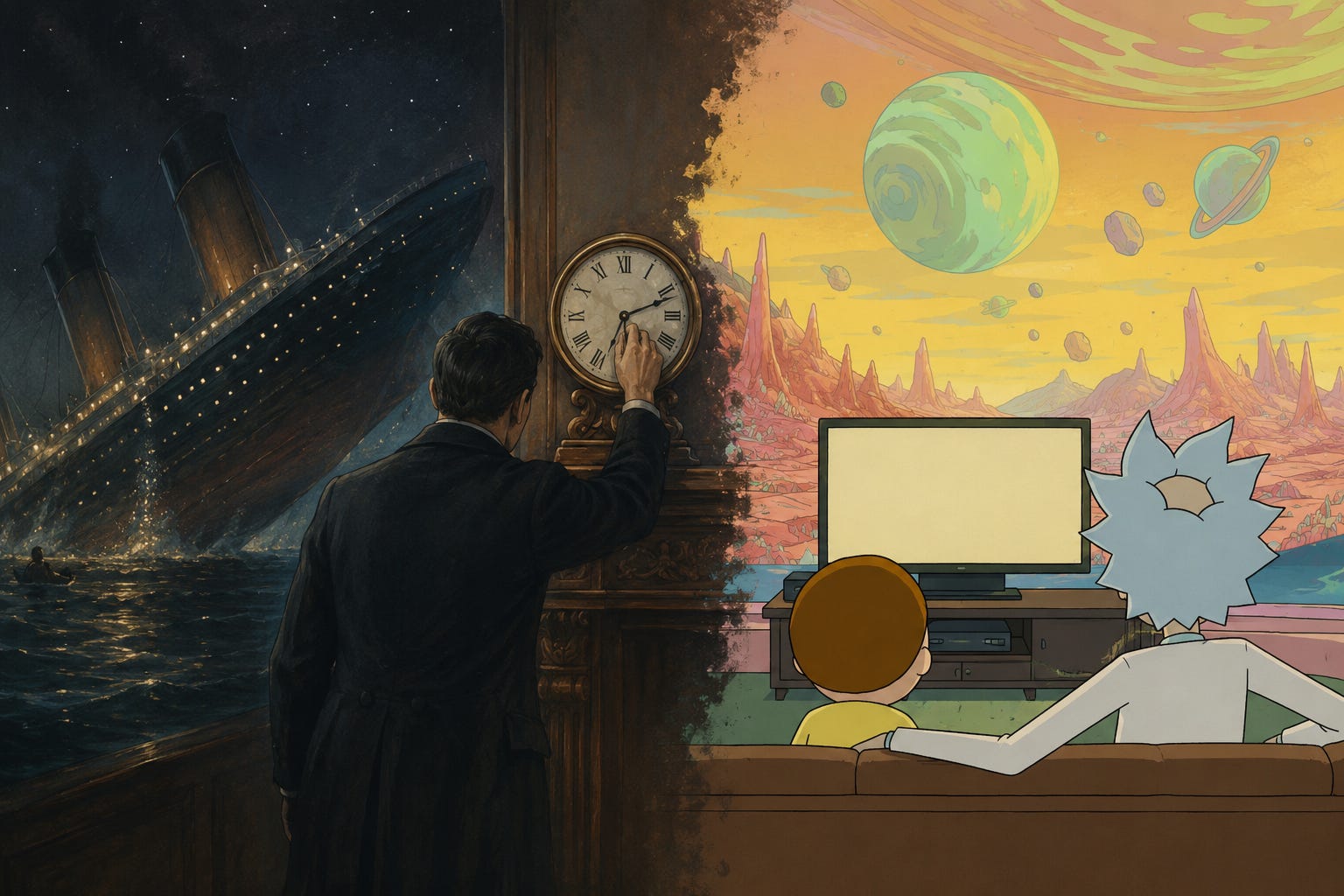
Come Watch TV
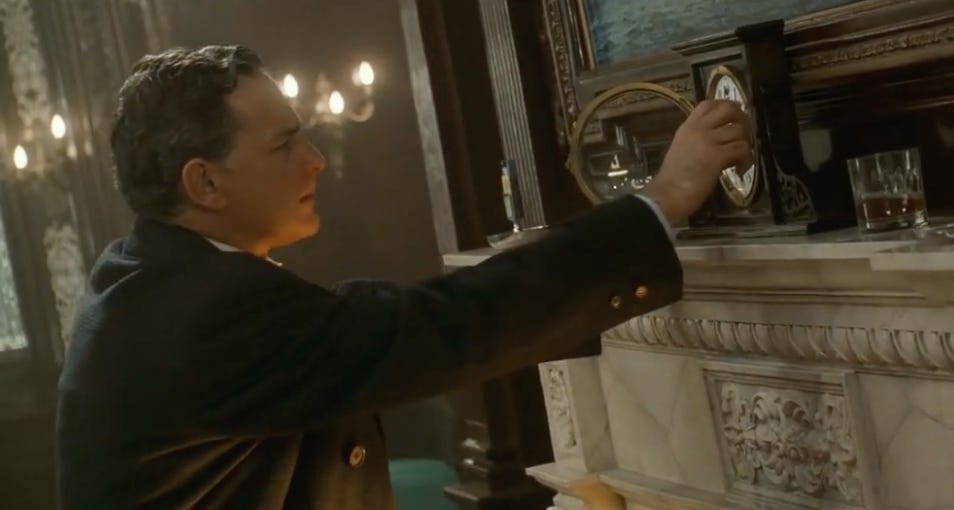
There is a small moment near the end of Titanic that has always stayed with me. Thomas Andrews, the ship’s chief engineering architect (played by the inimitable Victor Garber), is standing alone in the first-class smoking room as the ship is sinking beneath him. By this point he understands what is happening better than almost anyone aboard. He knows the ship cannot be saved, knows what his calculations mean for the people still trapped aboard, and seems to understand that he himself is probably going to die. As he stands there, surrounded by the remains of this extraordinary thing he helped create, he notices the clock on the mantel and comparing it to his own pocket watch, carefully adjusts the time.
It is such a delicate and subtle gesture that it would be easy not to notice it, particularly amid the enormous spectacle surrounding it. The room, already tilted to its sinking angle, will soon be underwater. The clock will be destroyed. And whether it is running a minute fast or slow should not possibly matter anymore. There is perhaps no moment in that clock’s existence when keeping accurate time could be less useful, and yet Andrews reaches up and corrects it anyway. I have always found the gesture strangely moving without being entirely sure why.
I was reminded of it recently by some considerably less solemn media: an episode of the animated series Rick and Morty. At the end of “Rixty Minutes,” the titular teenage boy character Morty is trying to comfort his elder sister Summer after she discovers something horrifying about the nature of their existence. Morty takes her outside and points to two graves in the backyard of their suburban home, one of which contains his own body—or, more accurately, the body of another Morty from a nearly identical universe. He explains that he and Rick (his grandfather) arrived to this reality after destroying their original world, and found versions of themselves who had just died, buried them in the backyard, and simply took their places.
Morty’s attempt at consoling Summer gives us one of my favorite lines from the series:
“Nobody exists on purpose.
Nobody belongs anywhere.
Everybody’s gonna die.
Come watch TV.”

The first three statements are what initially attract attention because they amount to a remarkably insightful and concise statement of existential nihilism, especially for an animated television comedy. But the more I have thought about that line, the more interested I have become in the final invitation. “Come watch TV” sounds like a joke that’s meant to release the tension created by everything preceding it, but it is also Morty’s actual answer to the problem he has just described.
That was when I thought about Thomas Andrews and his clock. Despite the enormous differences between these scenes, the characters seem to be responding to the same basic problem. Neither one is denying reality. Andrews isn’t adjusting the clock because he believes Titanic will somehow right itself and sail into New York Harbor, just as Morty isn’t reassuring Summer that everything happens for a reason or that somewhere beneath the apparent chaos of the multiverse there must be some grand design. Both characters have encountered a reality too large to control and have accepted it without qualification, but neither responds by concluding that everything smaller than that reality has therefore become worthless.
Instead, they return to something ordinary. Andrews adjusts a doomed clock and Morty watches inconsequential tv. Neither action alters the larger situation, which may be precisely why I find them so compelling. They suggest an alternative to the way we often talk about meaning, particularly our tendency to use meaning and purpose as though they were interchangeable. We ask what our purpose is, why we’re here, what we’re supposed to accomplish and what all of this is ultimately for, and when no satisfactory answer presents itself, the absence of purpose can begin to feel indistinguishable from the absence of meaning.
I am increasingly unconvinced that the two are the same thing. Purpose implies that something exists in order to accomplish something else, while meaning can exist entirely within the experience itself. Watching television with someone doesn’t need to accomplish anything beyond the experience of sitting beside that person and watching television. A conversation doesn’t necessarily need to produce insight, a hobby doesn’t need to become expertise, and a beautiful object doesn’t need to justify the space it occupies by being useful. These things can matter without being part of some larger system of objectives.
Most of what makes being alive worthwhile is actually remarkably bad at explaining its own purpose. Eating dinner with someone you love doesn’t solve anything, nor does listening to a song for the hundredth time, arranging objects on a shelf, making a martini exactly the way you like it, petting an animal, dressing beautifully when nobody important is going to see you, or staying up too late watching television with someone. We can invent purposes for these things if we want to, and we are very good at doing so. We can say that they strengthen relationships, promote psychological well-being, encourage creativity or provide emotional stability, but those explanations always seem strangely inadequate to me because they convert experiences into instruments. They imply that something worthwhile must ultimately be useful for something else.
This way of thinking has become so pervasive that even pleasure seems to require a business case. Hobbies become side hustles, exercise needs measurable goals, travel becomes self-development and reading becomes a yearly book count. Rest becomes “recovery,” which makes it valuable because it supposedly improves our productivity tomorrow. We seem deeply uncomfortable allowing an experience simply to terminate in itself, as though saying “I watched television because I wanted to watch television” were somehow an intellectually insufficient explanation for several hours of a human life.
Perhaps this is why catastrophe can reveal something that ordinary life conceals. When Titanic is sinking, the usual architecture of purpose has collapsed. There is no career advancement left for Andrews, no reputation to cultivate and no tomorrow for which he needs to prepare. The clock does not need to be accurate so that anyone can make an appointment later. Its practical utility is disappearing along with the ship, but Andrews’s impulse to adjust it remains.
I don’t think this necessarily means that Andrews has discovered some profound philosophical truth in his final moments, (in fact I prefer the scene without that interpretation). His gesture could be habit, professionalism, shock, an engineer’s instinct for order or simply the reflex of a person who sees something slightly wrong and corrects it. What makes the image affecting is that the action does not require a grand explanation. He spent part of his life helping to create and maintain this ship, and although he can no longer preserve the enormous thing, he can still attend to one tiny part of it.
Morty’s invitation for Summer to watch television with him is a much less elegant version of the same response, but perhaps an even more useful one. He possesses the kind of knowledge that should theoretically make ordinary life impossible. He knows that there are countless universes containing countless versions of himself and everyone he loves. He knows that the family he is currently living with isn’t technically the family into which he was born, and every time he looks into the backyard he can remember that he once buried another version of himself there. Nothing could more completely undermine the comforting idea that each of us occupies some unique and predetermined place in the universe.
Yet none of this prevents Morty from wanting to watch television with his sister. The universe doesn’t care whether they do, but Morty does, and perhaps that distinction is enough. The absence of a cosmic reason for an experience doesn’t prevent the experience from mattering to the people having it.
This is where I think nihilism sometimes makes an unnecessary leap. Even if we accept its most frightening premise—that there is no inherent cosmic purpose to human existence—it doesn’t necessarily follow that nothing matters. That conclusion only works if we have already decided that meaning must be issued by some external authority in order to be legitimate. If meaning can instead exist at the scale at which human beings actually experience life, then the lack of some larger explanation becomes considerably less devastating.
At that scale, meaning can reside in the person sitting beside us, the meal in front of us, the song playing in the room or the object we straighten because it is crooked. None of these things needs to explain our existence. They only need to make existence, for that particular moment, something in which we are still willing to participate.
I think this is also why versions of this phenomenon appear so often in ordinary life. Someone dies and eventually the dishwasher still needs to be emptied. A relationship ends while there are groceries in the refrigerator that are going to spoil. Terrible news arrives halfway through making dinner, or some entire period of your life ends and the following morning you still have to decide what shirt to wear. There can be something almost offensive about the persistence of these details, because the scale of the ordinary world suddenly seems grotesquely mismatched with the scale of what has happened.
And yet I have begun to wonder whether that mismatch is precisely what makes ordinary life valuable. The dishes and groceries and television programs do not diminish grief, mortality or catastrophe by continuing to exist alongside them. They give us a scale of existence that remains inhabitable when the larger one becomes overwhelming. We may not be able to do anything about mortality, or aging, or the fact that people and places we love will change, or the knowledge that eventually almost everything we build will disappear. But our inability to solve those problems does not prevent us from making dinner while knowing that they exist.
That seems to me a much more useful understanding of meaning than the constant search for purpose. I don’t need to demonstrate that my life serves some enormous objective before I am permitted to find it meaningful, nor do I need the universe to certify the importance of the people I love or the things that give me pleasure. Their impermanence doesn’t invalidate them, because permanence was never a prerequisite for experiencing them in the first place.
Perhaps this is what connects a clock on a sinking ocean liner to two cartoon characters sitting down in front of a television. Neither scene offers a solution to the enormous problem confronting its characters. The ship still sinks, Morty’s description of existence remains exactly as bleak after he delivers it, and nothing about reality has been repaired. What changes is the assumption that reality must first be repaired before something small can matter.
And maybe that is what I find so comforting about Morty’s invitation. “Come watch TV” isn’t an attempt to answer the question of why we exist. It is an acknowledgment that we may never receive an answer and that this does not prevent us from doing something we enjoy with someone we love. Thomas Andrews’s clock doesn’t need to survive the sinking to have been worth adjusting, just as an evening doesn’t need to last forever to have been worth spending together.
Meaning does not require purpose. Sometimes it requires nothing more than deciding that, for the moment we have available to us, this is what we are going to do.